





MOCVD laboratory
Contact info: doc. Ing. Novák Jozef, DrSc.
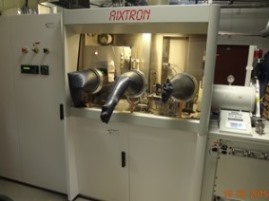
The MOCVD laboratory (established in July 1993) runs two epitaxial equipments from Aixtron provenience. The older equipment, AIXTRON AIX-200 R&D, is a standard research-oriented apparatus allowing growth of III-V semiconductor epitaxial layers and advanced heterostructures on GaAs, GaP, and InP substrates. Elements of group III are supplied from basic organometallic sources, such as trimethylgallium (TMGa), trimethylindium (TMIn), trimethylaluminum (TMAl), and group V elements are incorporated from hydrides, such as arsine (AsH3) and phosphine (PH3). Doping sources used are diethylzinc (DEZn) for Zn and silane for Si. MOCVD equipment is used for the preparation of epitaxial layers, heterostructures, and low dimensional structures in InxGa1-xP/GaAs, AlGaAs/GaAs, InxGa1-xAs/GaAs, and InxGa1-xAs/InP material systems.
Since December 2014 we operate a new Aixtron CCS flip top MOCVD system with shower head-type of reactor. It allows growth on 3×2 or 1×4-inch wafers. This equipment is dedicated for growth of GaN based epitaxial layers and structures. Recently TMGa, TEGa, TMAl, and TMIn sources are incorporated as group III element sources. NH3 serves as a nitrogen source while the silane is used for Si doping. The sources arrangement allows growth of GaN, InAlN, AlGaN, and InGaN layers and structures. Our goal is to optimise growth processes aiming the preparation of layers and heterostructures with high quality crystallographic structure interface quality on the atomic level for application in advanced transistor and photocathode structures.
Scope:
- MOVPE growth nitrides, arsenides, and phosphides
- Growth of doped and undoped nanowires including an analysis of early stages of nanowire growth
- Preparation of photonic structures based on NSOM lithography patterning
Equipment:
- MOVPE Aixtron CCS 3×2 shower head reactor for GaN and related compounds
- MOVPE horizontal equipment Aixtron AIX-200 for growth of arsenides and phosphides

contact for more info: Ing. S. Hasenöhrl, Ing. J. Kuzmík, DrSc.