






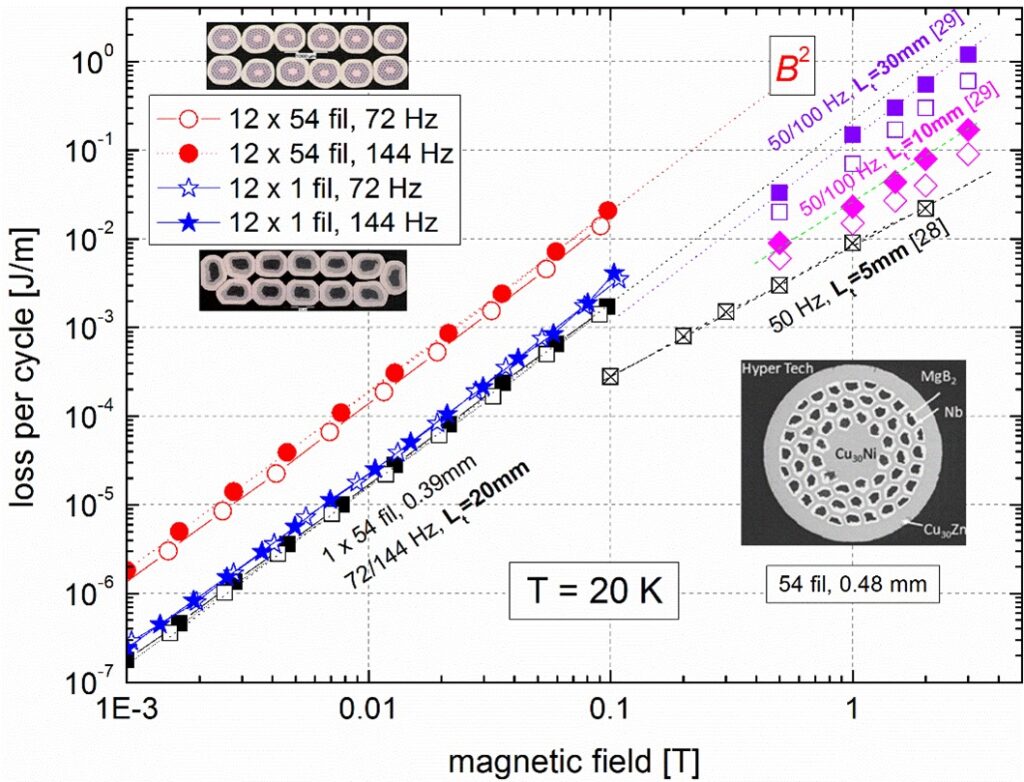
A 54-filamentary CuZn sheathed MgB2 wires produced by Hyper Tech Inc. were used to make a 12 strand cable of 0.70 – 0.76 mm thickness. The individual wires were wrapped around a core, obtaining a rectangular cross-section cable (so-called Rutherford cable, Fig.1). The threshold of engineering current density Je = 104 Acm-2 for the cable with dimensions of 0.72 mm x 2.55 mm was measured by Pavol Kováč and colleagues at a magnetic field of 4.5 T and temperature 4.2 K, and at 2.3 T for 20 K, respectively. The magnetization measurements of the cable with transposed strands and twisted 20 µm filaments have shown reduced AC losses, but the coupling currents loss contribution was still visible. The AC losses measured for a Rutherford cable with the same dimensions but made of single-core wires demonstrate the effect of well decoupled filaments. In spite of larger wire diameter (0.48 mm) and longer twist pitch (30 mm) of this wire, the calculated AC losses [28-29] are smaller than measured ones for the identical wire composition but smaller diameter of 0.39 mm and twist pitch of 20 mm. The presented measured and calculated Q(B) dependencies [29] shows that they are proportional to ~ B2, which allows us to extrapolate the total loss of Rutherford cable to higher external magnetic fields interesting for applications (1-2 T), which is not easy to do by experimental measurement.
28] Qiao Y et al. Sup. Sci. Technol. 38 (2025) 015024.
[29] Sogabe Y et al. Sup. Sci. Technol. 38 (2025) 035030.
Authors: Pavol Kováč, Ján Kováč, Dušan Berek, Matthew Rindfleisch, Marek Búran, Tibor Melišek, Imrich Hušek a Michael Tomsic
Link: https://www.sciencedirect.com/science/article/pii/S2772830725000237