






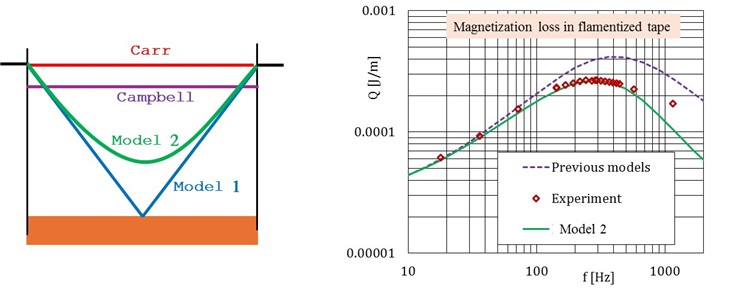
Composite tape conductors containing the high-temperature superconductor REBCO, deposited in a thin layer (1-2 µm) on a metal substrate and covered with a protective layer of silver and copper, are being considered for future accelerators and fusion reactors. It turns out, however, that it will be necessary to reduce the magnetic hysteresis (energy dissipation) by dividing the superconducting layer into several parallel strips, so-called filaments. In an experimental study of magnetic field penetration into tapes with different numbers of filaments and variable thickness of metal layers, Fedor Gömöry and his team found that existing theoretical models predict a systematically higher level of dissipation at frequencies above 100 Hz than we determined from our measurements. Two new models were proposed in turn: Model 1 assumes a linear decrease of the magnetic field from the tape ends towards its center [1], and Model 2 assumes an exponential decrease [2]. The theoretical predictions calculated using Model 2 agree with the previous models for low frequencies (Fig. 1). They differ from them for frequencies of 100 -500 Hz, where they agree very well with the measurement results. Based on these models, a more efficient superconducting devices can be developed, which are needed to reach green goals.
[1] Gömöry F. et al: Hysteresis and coupling loss in filamentized REBCO tapes, IEEE Trans. Applied Supercond. 35 (2025) 5900205. https://ieeexplore.ieee.org/document/10757360
[2] Gömöry F. et al:: Analytical model for coupling loss in filamentized high-temperature superconducting tapes, Superconductivity 15 (2025) 100193. https://www.sciencedirect.com/science/article/pii/S2772830725000444