






Superconducting bridges help electrical current bypass damage in a superconducting tape. Superconducting tapes can carry large electrical currents with very low losses after being cooled to very low temperatures. They can be found in applications such as power cables and powerful electromagnets. However, in a varying magnetic field, heat is generated in them as well, and energy is dissipated. One way to reduce these losses is to divide the superconducting layer of the tape into several narrow filaments [1].
However, such a division has a weakness: if one filament is damaged, the current flow through that location is harder. Short transverse superconducting bridges that interconnect individual filaments can help. They act similarly to cross-connections between roads — allowing the current to pass into the neighboring filament and bypass the obstacle. The damage does not disappear, but its impact on the tape’s operation can be reduced [2].
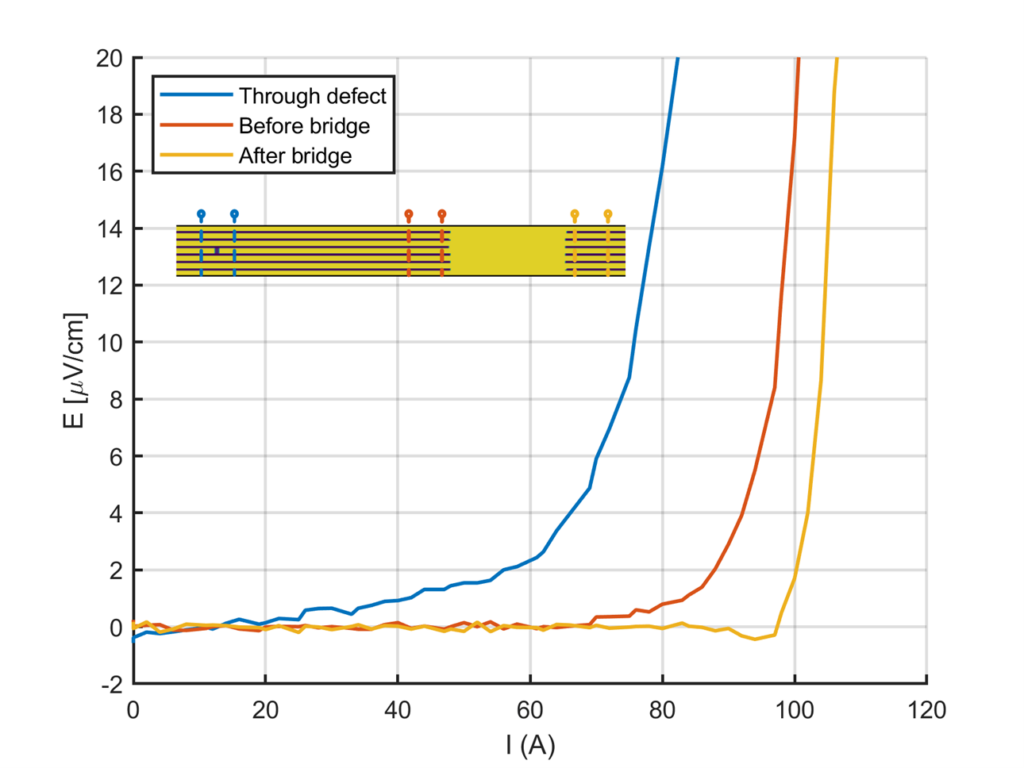
Tapes with separated filaments can be manufactured by depositing a superconducting layer on a specially shaped metallic substrate [3]. The effect of the bridges was investigated on a tape only four millimeters wide, divided into seven filaments. Measurements were performed in liquid nitrogen at approximately −196 °C and were complemented by computer simulations. After creating a small defect, the current distribution across different parts of the tape was observed. The measurements confirmed the beneficial effect of the bridges, although they did not match the simulations in all details.
Furthermore, the computer model showed that, in the studied arrangement, a bridge approximately 1 millimeter long was already sufficient, and the much longer, 10 millimetre long, was not necessary. Smaller bridges could thus be distributed more densely across the tape, thereby improving its tolerance to local damage. Without the bridge, the current in the model remained unevenly distributed up to twenty centimetres away from the damage, even at ideal conditions. However, before the new arrangement is put into practical use, its effect on energy losses must also be verified.
[1] Gömöry F et al. IEEE Trans. Appl. Supercond. 34 (2024) 5901605. DOI: 10.1109/TASC.2024.3364133.
[2] Levin G A, Barnes P N. IEEE Trans. Appl. Supercond. 15 (2005) 2158–2161. DOI: 10.1109/TASC.2005.849601.
[3] Wulff A C et al. Supercond. Sci. Technol. 28 (2015) 072001. DOI: 10.1088/0953-2048/28/7/072001.
Authors: Martin Kucharovič, Tomáš Kujovič, Fedor Gömöry, Marcela Pekarčíková, Christian R. H. Bahl, Anders C. Wulff, and Sara Landvogt.