





Reduction of energy and material losses caused by friction (tribological phenomena) in inert, vacuum, or chemically aggressive environments and in microscale systems requires dry lubricant systems since the classical liquid lubricants lose their efficiency in such conditions. The most promising lubricants for these applications include two-dimensional layered crystals of MoS2, graphene, or hexagonal-BN. However, modification of the surface frictional properties of these materials is relatively challenging. In contrast, graphene oxide (GO) offers more controllable mechanical, electrical, and tribological properties and allows modification of the surface by polymer chains or functional groups that, in turn, can change their tribological performance. Due to their low dimensionality, the tribological properties of the monolayer 2D materials have been mostly studied at the nanoscale, whereas on the macroscale, they are generally investigated as a component of the wet lubricants that are not applicable for extreme temperature or low-pressure environments. Our work reports on the impact of the grafting of the GO layers by polymer poly(methyl methacrylate) (GO-PMMA) and fluoropolymer poly(trifluoromethyl methacrylate) (GO-PTFEMA) brushes on their macroscale friction in both ambient air and vacuum conditions. Our results show excellent friction properties of the proposed coatings, leading to stable low friction of the coated surfaces during the tribotesting. In particular, in the ambient air environment, low friction was attributed to the formation of a friction-reducing carbon tribolayer, while in vacuum conditions, the friction reduction occurs by the formation of buckling ribbons from the substrate and an inhomogeneous tribolayer caused by the saturated carbon layers.
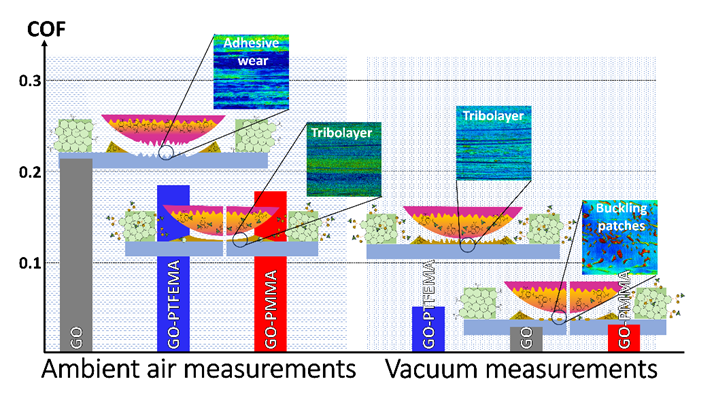
Figure: Relationship between the friction coefficient (COF) for GO, GO-PTFEMA, and GO-PMMA layers at atmospheric pressure and in a vacuum.
Authors: Kozak, A.O., Ilčíková, M., Babaei, N., Konios, N., Mičušík, M., Vretenár, V., Precner, M., Osička, J., Orovčík, Ľ., Eliáš, E., Dobročka, E., Hulman, M., Mosnáček, J., and Ťapajna, M.